Article from Around the World
Global Methane Genetics Jersey program scales up methane recording
The Global Methane Genetics Jersey Program has officially launched, marking an important milestone in the Jersey breed’s commitment to environmental sustainability and genetic improvement. This ambitious international initiative brings together researchers, industry partners, and Jersey organizations from Denmark, Canada, and the World Jersey association. Together, they form a strong collaborative platform to position the Jersey breed at the forefront of methane mitigation through dairy cattle breeding.
Data collection in Canada and Denmark
Canada has now purchased six of the funded methane sniffers, which will bring the national total to 12 MooLogger sniffers in operation. To date, methane emissions have been individually measured on approximately 500 Jersey cows in Canada. In Denmark, 10 funded sniffers have been installed, increasing the country’s methane recording infrastructure to 20 Guardian sniffers. Further expansion is expected, with additional support anticipated from the Danish Jersey fund “Jersey Support” for five more sniffers. Denmark has recorded methane measurements on approximately 6,500 Jersey cows.
Strong Global Jersey Support
The Global Methane Genetics Jersey Program is supported by 10 national Jersey associations through the World Jersey association. More countries are warmly welcome to join in the coming years. This growing international participation reflects a shared ambition across the Jersey community: ensuring the breed remains the “Dairy Queen” in a future where environmental performance is increasingly central to dairy production.
Historic Milestone: First Jersey Methane Evaluation Launched
On May 5th, the Nordic countries launched the world’s first official methane genetic evaluation for the Jersey breed, an important landmark for methane-mitigation breeding in dairy cattle. The evaluation draws on data from sniffers installed on Danish Jersey farms since 2016, and the funded sniffers by the Global Methane Genetics program are already contributing data. This evaluation gives Jersey breeders, for the first time globally, the opportunity to include methane emissions directly in selection decisions within the breed.
Next Steps in Research and Development
Researchers are currently focused on standardizing methane data outputs across sniffer technologies to ensure comparability between recording systems used internationally. Over the next year, the consortium will develop and validate a two-country genetic evaluation model for methane emissions, integrating data from Denmark and Canada. This represents the next major step toward a robust international methane breeding value for Jerseys.
Looking Ahead
The Global Methane Genetics Jersey Program demonstrates how international collaboration can accelerate innovation and strengthen the Jersey breed’s leadership in sustainable dairy production. Data will be exchanged between Canada and Denmark, while also encouraging additional national Jersey associations to invest in methane phenotyping and begin recording and sharing data. With expanding data collection, increasing international participation, and the first methane evaluation now operational, the Jersey breed is taking concrete steps toward a lower-emission future, while maintaining its reputation for efficiency, profitability, and adaptability.
________________________________________
Quotes from Project Leaders
Rasmus Bak Stephansen, Denmark Project Leader:
Breeding is increasingly recognized as an important long-term tool for mitigating methane emissions in dairy production, which is why genetics matters. With the Jersey breed playing a major role in the Danish dairy sector, it is important that Jersey breeders also have access to methane breeding values. Contributing to the global improvement of the ‘Dairy Queen’ through balanced breeding for profitability, efficiency, and sustainability is highly motivating.
Filippo Miglior, Canada Project Leader:
This is about making sustainability practical for breeders. Canada is expanding methane recording, and by working with Denmark and global Jersey partners, we are converting on-farm measurements into selection tools that help producers keep Jerseys efficient and profitable while moving toward lower emissions.
Olivier Bulot, World Jersey Representative:
“The Global Methane Genetics Jersey Program is a fantastic opportunity for international Jersey organizations to strengthen cooperation among all partners involved in genetics.
Already at the forefront of efficiency and sustainability in dairy production, the Jersey breed will continue to lead the way by using these new tools to accelerate the reduction of its global environmental footprint.”
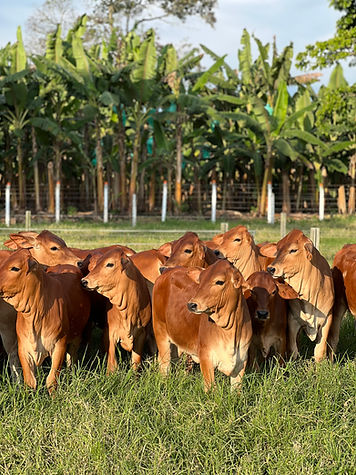
Crossbreeding with Jersey Genetics on Zebu : a winning solution in Latin America
Tropical dairy systems need cows that produce well, survive heat, and stay healthy. In Latin America, the solution is increasingly clear: Jersey genetics and strategic crossbreeding :
-
Heat tolerance
-
High-quality milk (fat & protein)
-
Strong health and fertility
-
More profitable per hectare
Results:
More litres of milk where it matters: on pasture, under heat, with real profitability
Whether with purebred Jersey or strategic crosses, Jersey genetics are shaping the future of sustainable tropical dairy.
Want to know more ? Download the full article written by AsoJersey Colombia :